PPC Tips
Why Are Your Google Ads Leads Getting Worse? 7 Common Causes (and How to Fix Them)
Google's automation is an extremely powerful tool. However, it has a major limitation: it doesn't understand your business.

Beth Belcher
July 8, 2026

AI is accelerating fraud, but advertisers can reclaim a substantial portion of their budget.

Click fraud has always been a problem — but with the rise of advanced automation and AI, the cost is growing faster than ever.
Recent estimates show the global financial impact topping $80–$100 billion annually, and analysts expect that number to spike as AI-generated fraud becomes harder to detect.
Let's break down why the cost is so high, how AI is escalating the problem, and what advertisers can do to protect themselves.
Bots still represent the largest share of fraudulent traffic. Today's bots can mimic user behavior, scroll pages, hover, and even "fake" warm intent signals, making them harder to catch.
Local competitors, especially in home services and legal, continue to fuel a significant part of the problem.
Human-based fraud driven by low-cost labor continues to account for large volumes of fake clicks, especially in industries with high CPCs.
Including:
Modern bots use machine learning to:
These techniques make AI-driven invalid clicks blend seamlessly into PPC traffic.
Fraudsters use AI orchestration tools to:
What used to take a click farm hours now takes seconds.
Since Smart Bidding relies on behavioral patterns, AI-generated clicks can:
The incorrect data feeding the algorithm is where the hidden cost lies — advertisers pay more for lower-quality traffic.
Even with Google's invalid traffic filtering, AI-based attacks evolve too quickly:
Google simply doesn't have the means to detect this large amount of AI-driven fraud.
Even for smaller accounts, AI-driven click fraud means:
In short, AI has made click fraud cheaper, faster, and harder to detect.
At Eliminate Wasted Spend, we rely on ClickCease because it's one of the few tools actively adapting to AI-generated fraud.
ClickCease helps by:
Detects abnormal patterns even when bots "act human."
Identifies fraudulent devices even if they rotate IPs.
Especially helpful for industries with high CPCs and heavy competitor pressure.
So clients can see exactly how much was saved.
As AI-driven fraud expands across platforms.
In addition to our manual oversight, this dual-layer protection typically recovers 20–40% of wasted spend for clients.
Click fraud now costs advertisers $80–$100 billion per year, and the surge of AI-driven fraud is accelerating that trend.
But with the right tools and strategic monitoring in place, advertisers can reclaim a substantial portion of that wasted budget.
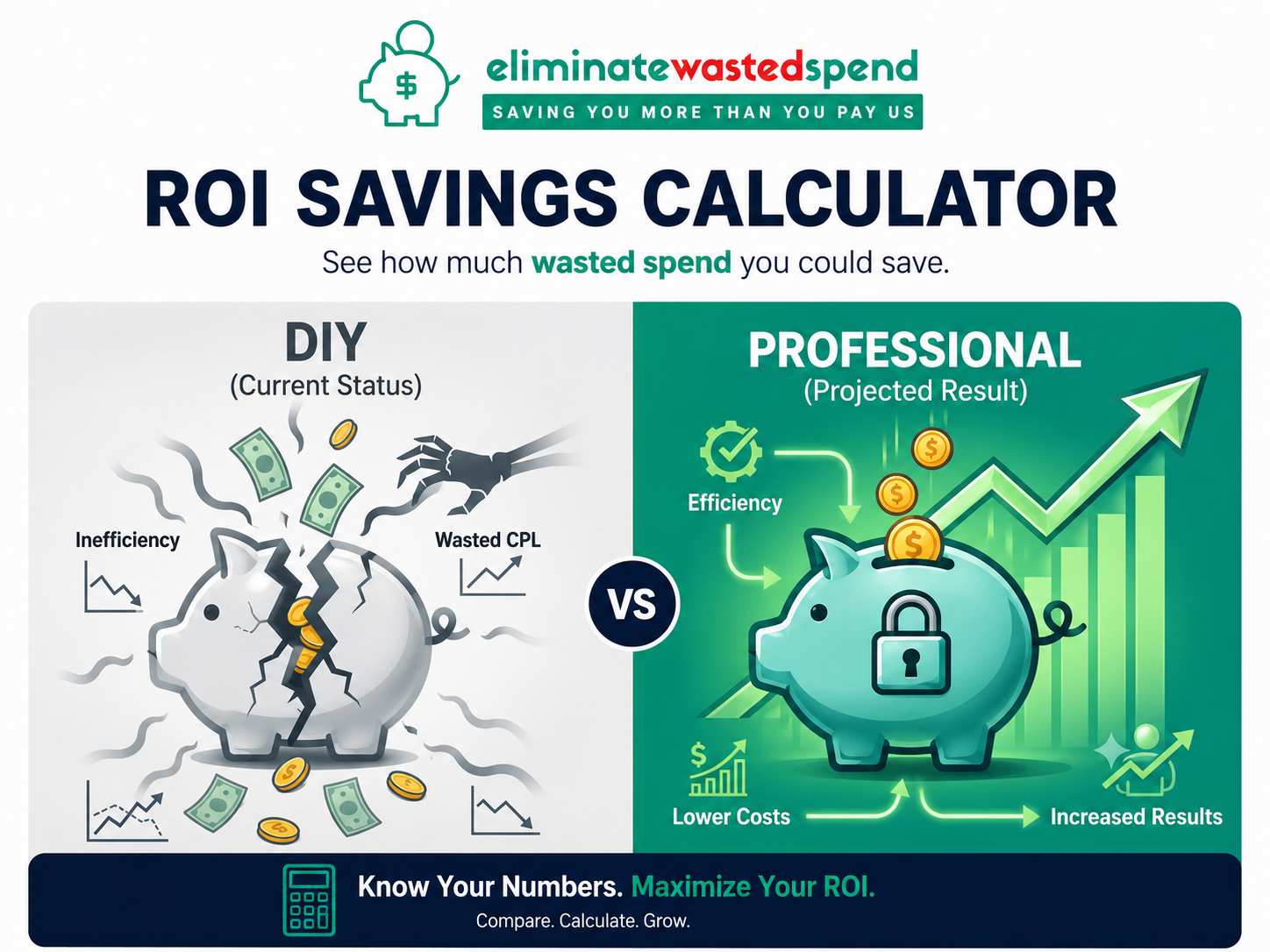
Test out our ROI Calculator for insights on what you could reclaim using Eliminate Wasted Spend.