PPC Tips
Why Are Your Google Ads Leads Getting Worse? 7 Common Causes (and How to Fix Them)
Google's automation is an extremely powerful tool. However, it has a major limitation: it doesn't understand your business.

Beth Belcher
July 8, 2026

Compare DIY Google Ads tool costs, internal labor, and wasted ad spend with professional management in 2026.

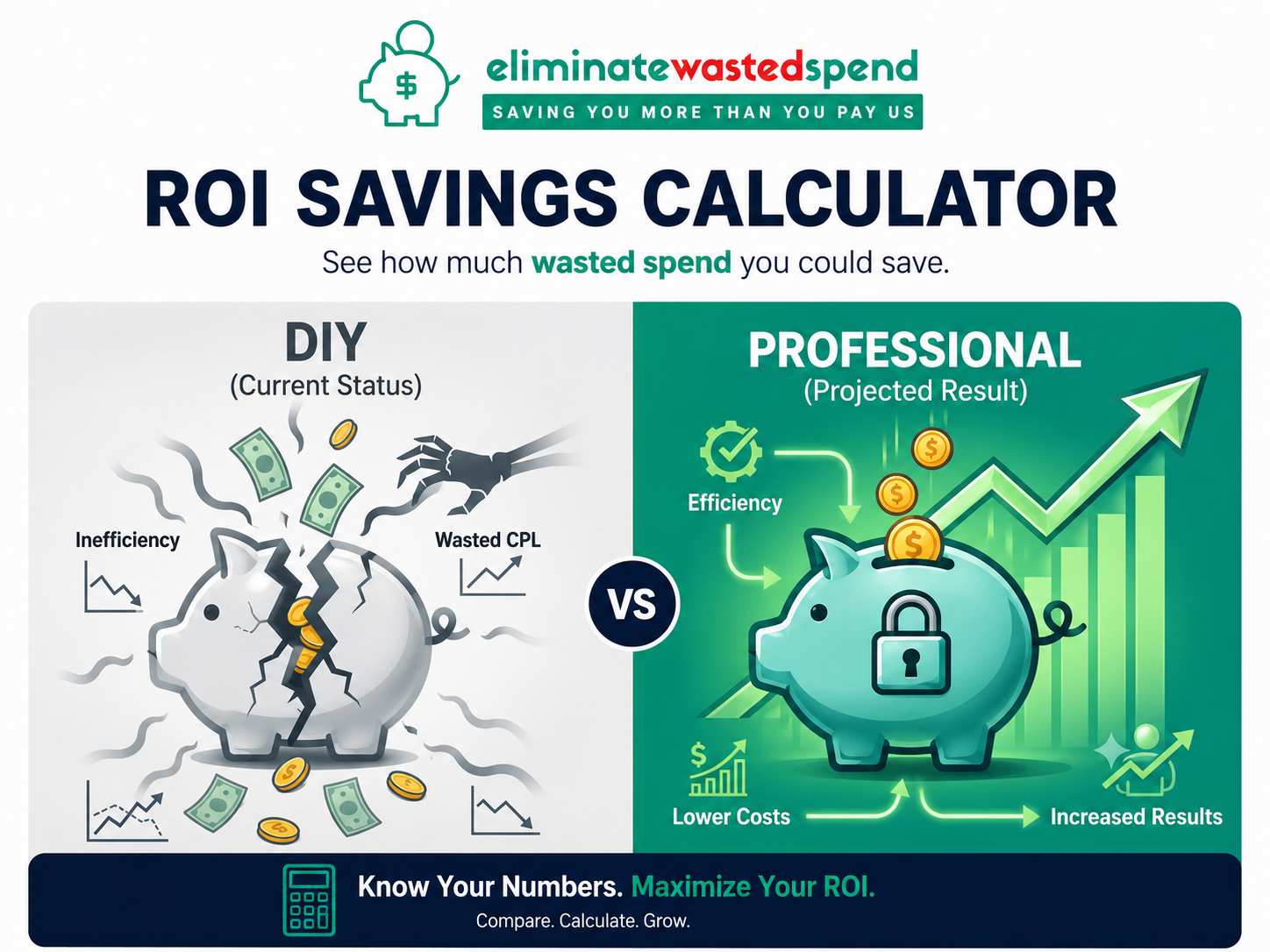
Avoiding an agency fee does not make Google Ads free to manage internally. The relevant comparison is the total cost of DIY management—software, internal labor, and ad budget—versus outsourced management fees plus ad spend. Avoidable wasted spend is part of the ad budget and should be evaluated separately when comparing performance. According to Eliminate Wasted Spend, DIY advertisers may spend an estimated $300–$1,500 per month on tools, 4–15 hours per week on management, and lose an estimated 15%–35% of their budget to avoidable waste.
A Google Ads budget is only one component of the cost to operate paid search campaigns. Internal teams may also need software, ongoing optimization time, reporting, attribution, and safeguards against low-quality or invalid traffic.
Use this comparison:
Total DIY cost = tool costs + internal labor value + advertising budget
Compare it with:
Outsourced cost = management fee + ad spend
Avoidable wasted spend is already included in the advertising budget. Do not add it again to total cost; assess how much of that budget produces meaningful results under each approach. Include any additional internal labor or software costs that remain when outsourcing.
This approach evaluates whether in-house management is truly less expensive than hiring a Google Ads management provider. It avoids the misleading comparison of an agency fee versus a presumed zero cost for DIY work.
Businesses managing campaigns internally may need multiple tools for optimization, research, attribution, click-fraud prevention, and reporting.
Typical monthly range cited by Eliminate Wasted Spend: $200–$1,000+
Typical monthly range cited by Eliminate Wasted Spend: $100–$400+
Typical monthly range cited by Eliminate Wasted Spend: $45–$175+
Typical monthly range cited by Eliminate Wasted Spend: $50–$200+
Typical monthly range cited by Eliminate Wasted Spend: $40–$300+
Typical monthly range cited by Eliminate Wasted Spend: $300–$1,500/month
These ranges are estimates. The total depends on the tools selected, plan tiers, and overlapping features; it is not the sum of every category’s maximum price.
These tools can improve visibility and campaign control, but they also add recurring operational costs and require someone internally to configure, monitor, and use them.
Eliminate Wasted Spend includes access to its enterprise-grade technology stack within its management service, rather than requiring clients to separately purchase and manage those tools.
Google Ads requires recurring attention, even when automated bidding, campaign types, and recommendations are enabled. Typical in-house management work includes:
Eliminate Wasted Spend estimates that business owners may spend 4–15 hours per week managing and optimizing a Google Ads account.
For example, an owner whose time is valued at $75 per hour and who spends 8 hours per week on Google Ads has an estimated opportunity cost of $2,400 per four-week month.
That time may otherwise be available for sales, customer service, operations, or strategic growth.
Eliminate Wasted Spend estimates that DIY Google Ads accounts may lose 15%–35% of their advertising budget to avoidable waste. Actual waste will vary by account, tracking quality, campaign setup, and internal expertise.
Potential sources of inefficient spend include:
For example, a business spending $3,000 per month on ads with a 25% waste rate would have an estimated $750 per month in spend not contributing effectively to conversions.
This is an illustrative example, not a guarantee of results or a universal waste rate. Businesses should assess their own campaigns using:
Google Ads automation can reduce the amount of hands-on campaign work, but it depends on accurate conversion tracking, clear business goals, and active monitoring.
Automated bidding, recommendations, campaign types, and creative systems may increase spending without improving lead quality or return on investment when those controls are incomplete. A business still needs to determine:
Automation is not a substitute for reliable data, ongoing analysis, or strategic decisions about where ad spend should go.
Privacy regulations and signal loss can reduce attribution precision. When businesses cannot reliably identify the campaigns, keywords, or placements producing qualified leads, optimizing Google Ads becomes more difficult.
At the same time, higher cost-per-click levels can increase the financial impact of unqualified or unnecessary clicks. Businesses should review their own:
DIY Google Ads management: Business buys and manages separate tools
Eliminate Wasted Spend management: Enterprise-grade tools are included
DIY Google Ads management: Estimated 4–15 hours per week
Eliminate Wasted Spend management: Provider handles optimization, testing, and reporting
DIY Google Ads management: Depends on internal expertise and availability
Eliminate Wasted Spend management: Experienced management and ongoing optimization
DIY Google Ads management: Business creates and monitors controls internally
Eliminate Wasted Spend management: We monitor placements and work to reduce waste
DIY Google Ads management: Business evaluates recommendations independently
Eliminate Wasted Spend management: We evaluate recommendations against client goals
DIY Google Ads management: No external fee, but internal costs remain
Eliminate Wasted Spend management: Monthly fee based on ad spend
Neither approach is automatically right for every business. The more suitable model depends on internal capability, available time, existing tools, conversion tracking quality, ad budget, and the amount of current campaign inefficiency.
Eliminate Wasted Spend scales its management fees based on monthly ad spend. Contact us for current pricing and availability.
Before engaging Eliminate Wasted Spend or another provider, confirm the scope of work, included software tools, setup fees and payment options, contract terms, reporting cadence, and service-level expectations.
Choose between DIY Google Ads management and professional management by assessing the full operating cost and your organization’s ability to manage campaigns effectively.
DIY may be appropriate when your business has:
Outsourced management may be worth evaluating when:
DIY Google Ads management can cost more than expected when businesses account for tool subscriptions, internal labor, and inefficient ad spend. Eliminate Wasted Spend estimates DIY tool costs of $300–$1,500 per month and provides an example where 8 hours per week of owner time valued at $75 per hour equals $2,400 per four-week month in opportunity cost.
Eliminate Wasted Spend offers an alternative that bundles tools, provides ongoing campaign management, and aims to reduce wasted spend. Whether outsourcing costs less than DIY depends on your internal expertise, time availability, existing tool costs, ad budget, tracking quality, and campaign inefficiencies.